Free Guide · 20 Pages

The D1 Blueprint.

What actually matters in hockey development at every age from 7 to 18, written by Logan Acheson: KC minor hockey, AJHL captain, four years of NCAA Division I, and now pro. It's free, and it goes straight to your inbox.

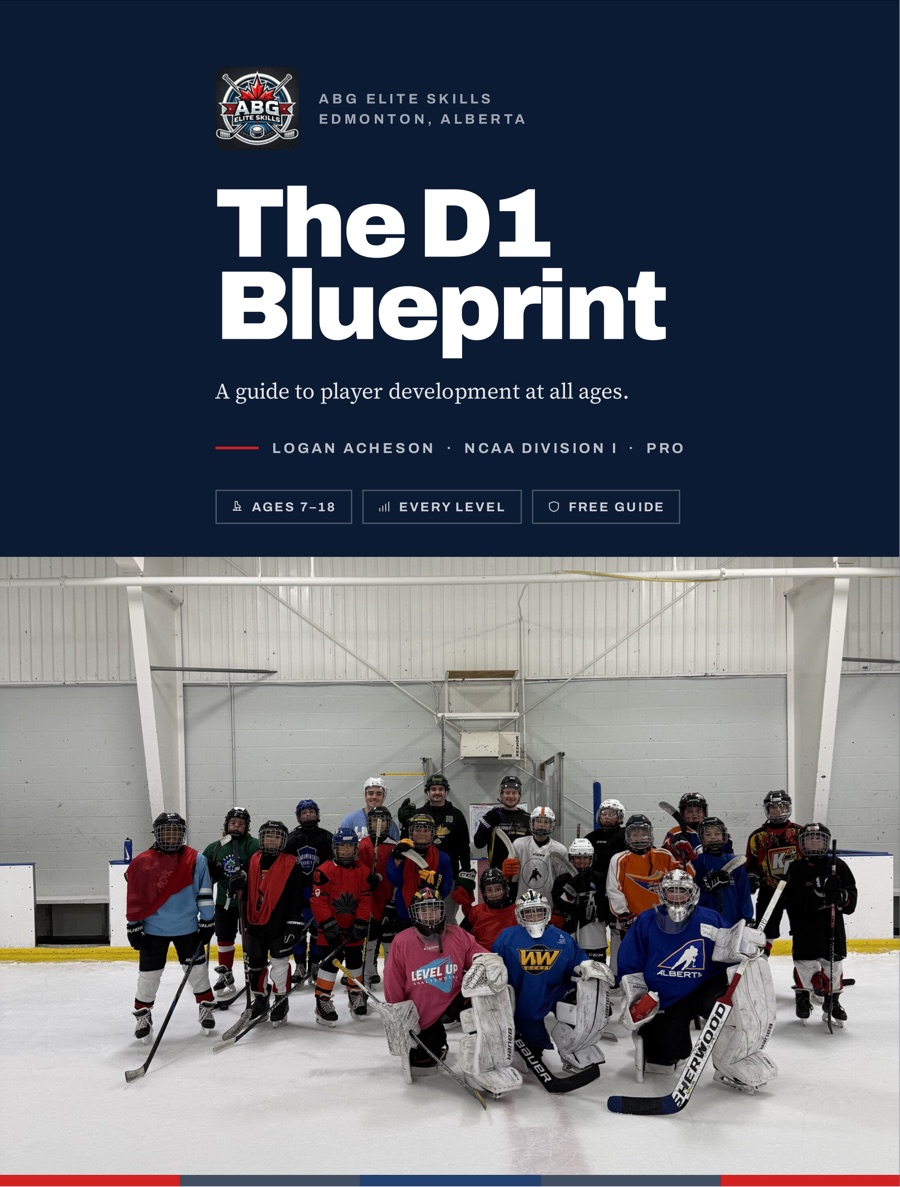
Cover of The D1 Blueprint, a guide to player development at all ages by Logan Acheson
None of these require exceptional skill. They're choices.
From The D1 Blueprint, page 10
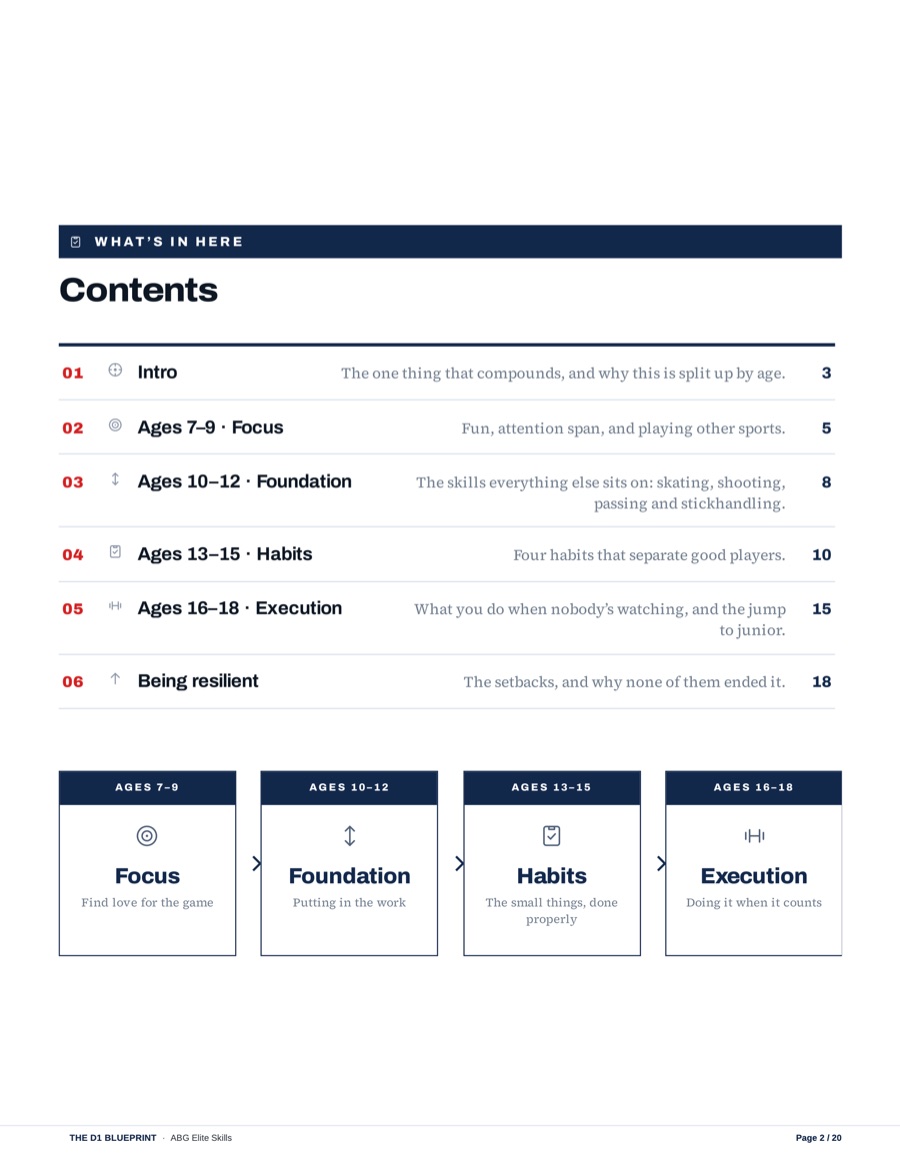
  1. 01 FocusAges 7 to 9 · Find love for the game
  2. 02 FoundationAges 10 to 12 · Putting in the work
  3. 03 HabitsAges 13 to 15 · The small things, done properly
  4. 04 ExecutionAges 16 to 18 · Doing it when it counts
Logan Acheson

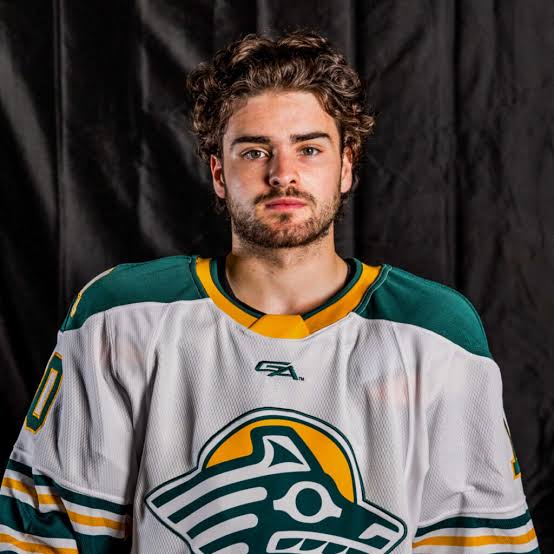
Written by Logan AchesonFounder of ABG Elite Skills · Pro, NCAA Division I

Where should we send it?

We'll email the PDF right away, and you'll be first to hear when summer 2027 camps open.

Why It's Split By Age

The right work at the wrong age doesn't help.

Two kids can go to the same practices, with the same coach, for years and end up at completely different levels. The most useful thing a young player can learn is how to focus and listen, because it's the one skill that compounds every single time they're on the ice.

A lot of what hockey families spend money, time, and worry on is the right thing at the wrong age. The ages below are a guide, not a rule. Players develop at different rates, so read the stage that matches where your player actually is.

The D1 Blueprint, stage by stage

01

Ages 7 to 9

Focus

Fun matters at this age, but not for the reason most people think. A kid who's enjoying it holds focus, and a kid who holds focus takes in what's being taught. At seven, eight, and nine, fun is how the development happens.

What actually separates players

  • Attention span. The same drill lands completely differently for a kid who's locked in and a kid who's somewhere else mentally.
  • Copying a drill properly. Can they take what a coach just demonstrated and reproduce it properly, not roughly? That's what attention span looks like on the ice.
  • Wanting the puck. Turnovers at eight usually mean a player is trying something. That's what you want.
I didn't specialize in hockey until I was fifteen. You learn body control, hand-eye, awareness, and better feet from other sports, and it keeps kids fresh.

What to work on

  • Small-area games and compete drills over full-ice games
  • Another sport, in another season
  • The right stick flex, a stick between the chin and nose on skates, and a sensible sharpening

What matters less

  • Which team or tier they're on
  • Points and lines, which track physical maturity more than skill
  • A fixed position, since playing everywhere through twelve teaches more
  • Daily ice and year-round hockey-specific training
02

Ages 10 to 12

Foundation

This is where skating, shooting, passing, and stickhandling get built. Everything later in a player's development assumes these are already there.

What actually separates players

  • Skating, and specifically edges. Stopping, turning, inside and outside edges, and accelerating. For every stop or turn on the good side, practise two on the bad side.
  • Puck touches, not ice time. An average NHL forward has the puck for about forty seconds a game. Touches come from small-area games and from work away from the rink: a golf ball on the rug, a tennis ball off the wall, the outdoor rink.
  • Getting pushed. Skating with better players is uncomfortable at first, and it's the fastest way to improve.
My first year in every age group I never made the top team, so I'd affiliate up and practise with them. My second year in the age group, I always made it. U9, U11, U13, U15. Every time.

What to work on

  • Edges and stops, two reps on the weak side for every one on the strong side
  • Stickhandling in motion with the eyes up
  • One-touch passes off a wall or rebounder, both sides
  • Skating at speed, with a puck

What matters less

  • What tier they're playing
  • Being the best player on their team
  • Top-of-the-line gear
03

Ages 13 to 15

Habits

This is the age where details start deciding games. As players hit growth spurts and the speed goes up, talent alone stops being enough. None of the habits that matter most require exceptional skill. They're choices.

The four habits to watch for

  • Shoulder checks. Looking before the puck arrives, so they already know their options and the pressure coming.
  • Stopping at the net. Finishing every rush at the crease instead of peeling off, which is where most goals are scored.
  • Calling for passes. A vocal player makes the whole unit play a beat faster.
  • Stick on the ice. A ready target for passing windows that only stay open for a split second at higher levels.
At Alberta Cup tryouts I couldn't reach halfway down my shins in the cool-down stretch. I've stretched for ten minutes almost every night since I was fourteen, and I've dealt with very few injuries because of it.

What to work on

  • The four habits, until they happen without being asked
  • Ten minutes of mobility, nightly
  • Sprints, agility, and jumps: an athlete first, not only a hockey player
  • Daily shooting and stickhandling volume, however small

What matters less

  • The WHL draft. I wasn't drafted and played Division I anyway.
  • Size, beyond playing to the build you have
  • One bad season
04

Ages 16 to 18

Execution

By sixteen, almost everyone has solid skating and hands. What separates players now is earned confidence: knowing the work already happened, so they can stop thinking and just play.

What actually separates players

  • The work nobody sees. Early skates, extra mobility, and reps in the driveway that nobody asked for.
  • Poise and identity. Not rattled by a bad shift or a benching, and clear on the two or three things they bring every night.
  • Studying video. Their own shifts first, then the players who do it best.
  • Play away from the puck. Even top players have it for forty to fifty seconds a game. The rest is positioning, defending, and support.
My first full season of junior, I didn't score a goal and I was getting scratched. Then I trained at home for hours a day. When we played again, I went from the sixth or seventh defenceman to the number one guy, and the season after that I was captain.

What to work on

  • Extra work on their own time, which is where real confidence comes from
  • A short memory for mistakes
  • Video: routes, gap control, and details away from the puck
  • A real strength program, sleep, and eating enough to recover

Worth knowing

  • Junior is a bigger jump than anyone expects, and a hard first year is common
  • The players who come through it treat year one as an apprenticeship

Being Resilient

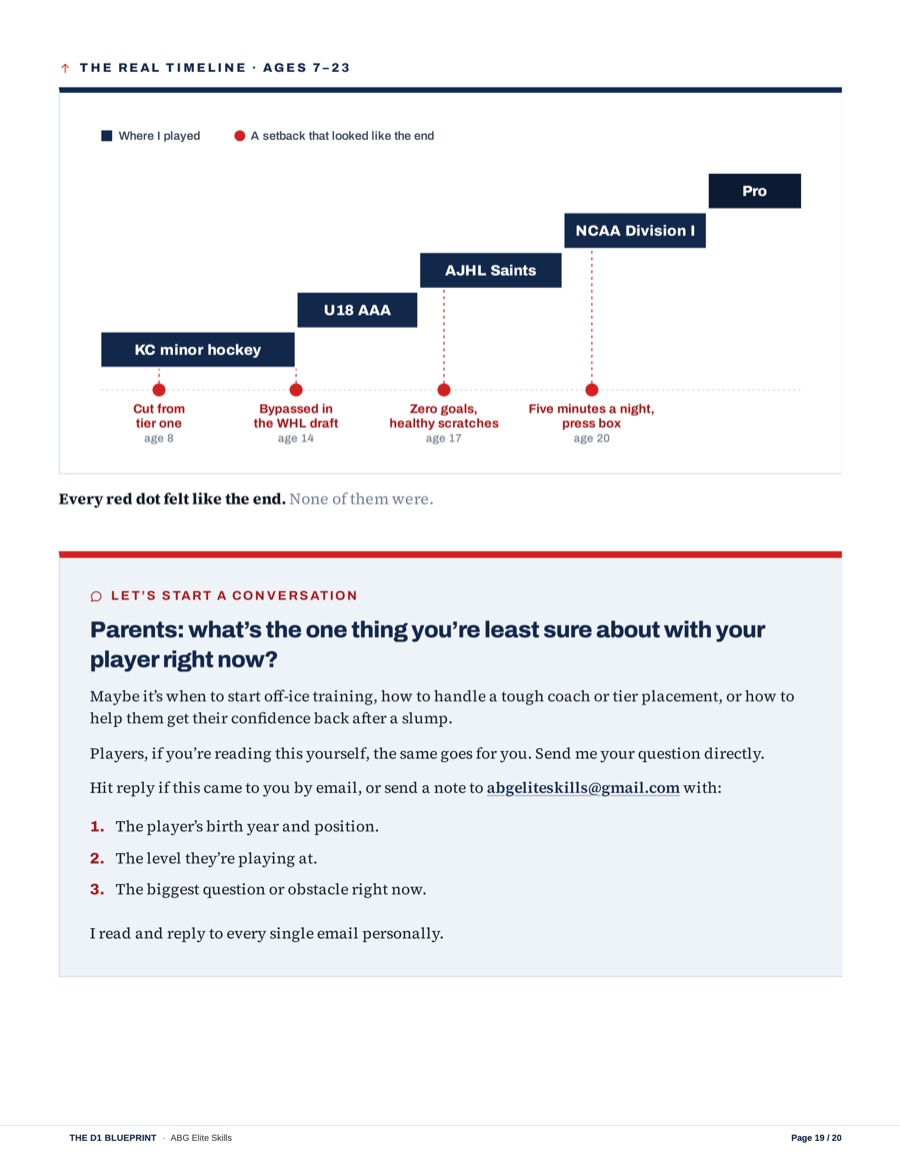
Every setback felt like the end. None of them were.

Nothing that happens to a young player is a verdict. The guide closes with the setbacks from Logan's own career, and what he did with each one.

  1. Age 8Cut from tier one
  2. Age 14Bypassed in the WHL draft
  3. Age 17Zero goals, healthy scratches
  4. Age 20Five minutes a night, press box
  5. NowFour years of NCAA Division I, now playing pro

FAQ

About the D1 Blueprint.

Still have a question? Email abgeliteskills@gmail.com.

Who is the D1 Blueprint for?

Hockey parents with players between 7 and 18 who want to know what actually matters at their player's stage, and players who want to read it themselves. It's written for every level, not just elite players.

Is it really free?

Yes. Enter your email and the 20-page PDF arrives right away. You'll also be first to hear when summer 2027 camps open.

Who wrote it?

Logan Acheson, founder of ABG Elite Skills. He played all of his minor hockey with KC in Edmonton, captained the Spruce Grove Saints in the AJHL, played four years of NCAA Division I at the University of Alaska Anchorage, and now plays professionally.

Can I ask about my own player?

Yes. Reply to the email the guide comes in with your player's birth year, position, level, and your biggest question. Logan reads and answers every one himself.

Want Eyes On Their Game?

Put the Blueprint to work.

Send in game clips and one of our NCAA or pro coaches records a breakdown of your player's positioning and decisions, or book a 1-on-1 mentorship call.